
A crypto arbitrage chain may continue to show a trading opportunity while becoming impossible to execute. In spot arbitrage, this happens when previous trades have already changed the distribution of assets across exchanges.
Consider a simple chain: BTC is bought with USD on Binance, while the same amount of BTC is sold for USD on KuCoin. To execute this chain, the trader needs USD on Binance and BTC on KuCoin.
After the trade, the balances change: Binance holds less USD and more BTC, while KuCoin holds less BTC and more USD. If the same direction repeats, assets gradually accumulate on the side where they are not needed for the next execution. The price difference may still exist, but there may no longer be enough USD on Binance or BTC on KuCoin to execute the next trade.
This limitation appears after execution and is caused by the way spot crypto arbitrage trades change the distribution of assets across platforms.
Why Balance Restoration Matters in Spot Crypto Arbitrage
Balances can be restored through transfers between exchanges: in this example, BTC would need to be moved back to KuCoin, while USD would need to be returned to Binance. But transfers become a separate part of the trading process: they cost money and depend on whether deposits and withdrawals for the relevant asset are available on both exchanges.
Transfers of BTC and ETH can be noticeably more expensive than transfers of assets that can be moved through low-cost networks. In some cases, the problem is more serious: a price difference exists, but deposits or withdrawals for the asset are restricted on one of the exchanges. After several executions, funds may accumulate on a platform from which they are difficult to bring back into active trading.
In this situation, a trade in the opposite direction becomes an alternative to a transfer.
How a Reverse Chain Restores Asset Distribution
If the initial chain buys BTC on Binance and sells it on KuCoin, a reverse chain does the opposite: it buys BTC on KuCoin and sells it on Binance.
This moves funds back in the opposite direction: USD returns to Binance, where it is needed for purchases, while BTC returns to KuCoin, where it is needed for sales.
A reverse chain does not need to be profitable. If it restores the asset distribution required for subsequent trades without a separate transfer between exchanges, it already serves its purpose.
How HETHA.IO Supports Reverse Chains in Crypto Arbitrage
HETHA.IO provides the Force Reverse mode for working with the reverse direction. Its activation and reverse deal parameters are configured by the user.
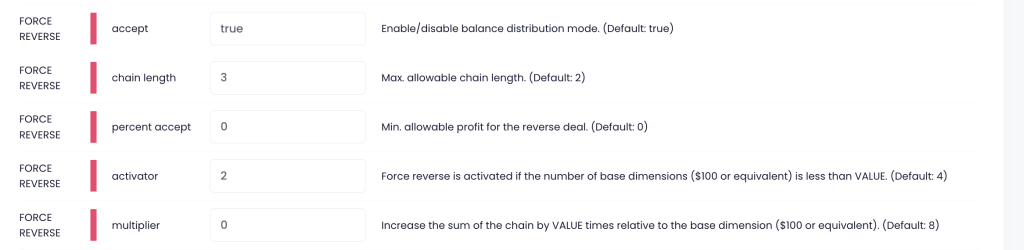
Force Reverse settings allow the user to configure when reverse distribution is activated and how reverse chains are processed.
The Activator parameter defines the remaining number of available base volumes: if their number falls below the value set in the settings, reverse distribution mode is activated.
After execution, the movement of funds can be tracked in the Moneyflow section to see how trades change the distribution of assets across platforms.
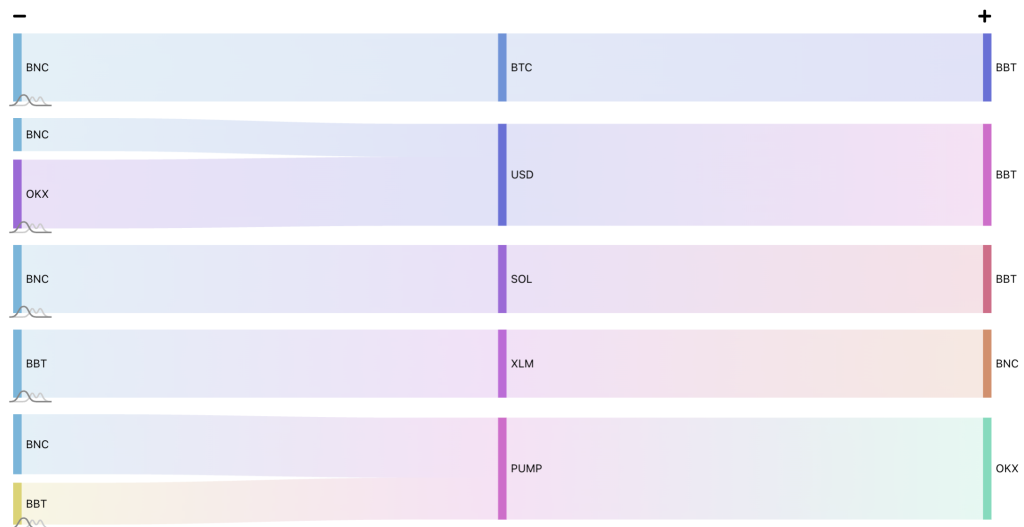
Moneyflow shows how executed trades affect the distribution of assets across exchanges over time.
When spot crypto arbitrage chains are executed repeatedly, a trade does not end when its orders are closed: it leaves a new distribution of assets across exchanges. If direct chains continue moving funds in only one direction, a reverse path makes it possible to restore a workable balance through trading rather than through constant transfers between exchanges.