
What Is Generation Time in Arbitrage Trading
Most discussions about arbitrage revolve around spreads, execution speed, and fees. These factors are visible, measurable, and easy to reason about. But in real systems, there is a parameter that is rarely discussed — yet it determines whether a trade even exists at the moment you see it.
This parameter is generation time.
In arbitrage trading, generation time is the delay between the last relevant market update and the moment an arbitrage opportunity is calculated and delivered. In other words, it represents the gap between the actual state of the market and the decision based on that state.
Under normal conditions, this delay is measured in fractions of a second, typically up to ~0.1 seconds. Under heavier load, it can reach 0.5-1 second — and at that point, a trade is already considered unreliable and is often discarded.
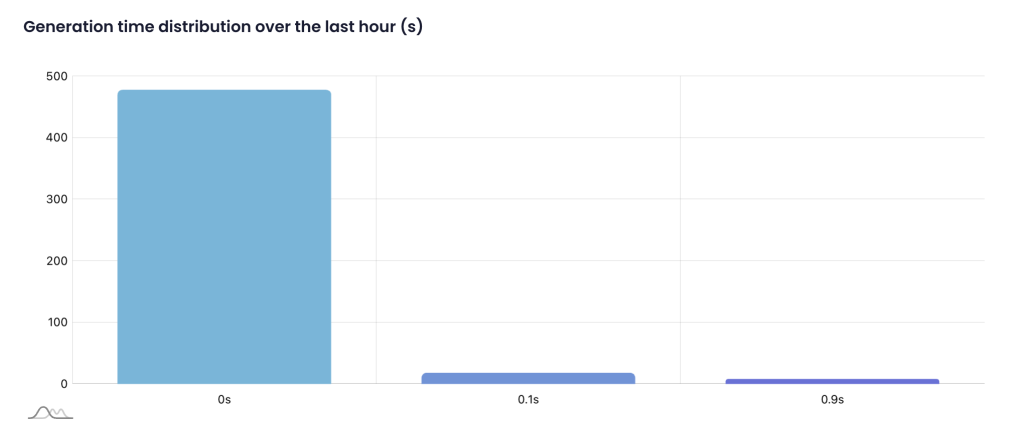
Distribution of generation time in an arbitrage system — most chains are generated within milliseconds, but even small delays become critical.
Why Generation Time Is Critical for Arbitrage Execution
Arbitrage is often described as a simple process: identify a price difference and execute a trade. In reality, this model ignores how quickly markets change.
Speed alone is not enough. It is not just about executing fast — it is about executing an opportunity that still exists.
By the time an arbitrage opportunity is executed, it is already based on previously processed data. If the market has changed during that time, execution may still be fast — but it is no longer aligned with current market conditions.
This is one of the main reasons why many arbitrage strategies fail in practice.
How Market Changes Make Arbitrage Opportunities Obsolete
Financial markets are dynamic environments. Order books constantly change: liquidity disappears, prices shift, and volumes redistribute across levels.
In multi-leg arbitrage, this effect compounds. Each step in the chain depends on the previous one still being valid. Even a small delay can make the entire chain non-executable.
For example, a chain with a 0.1-second delay may still reflect the market, while a chain with a 0.9-second delay often operates on outdated conditions. Even if the nominal profit appears identical, the execution outcome can be completely different.
Why Most Arbitrage Opportunities Never Reach Execution
In real systems, most arbitrage opportunities never reach execution. They are discarded earlier because they are no longer valid.
A typical arbitrage engine processes large volumes of market data, generates many potential opportunities, and filters out most of them. Not because they are unprofitable, but because they no longer match current market conditions.
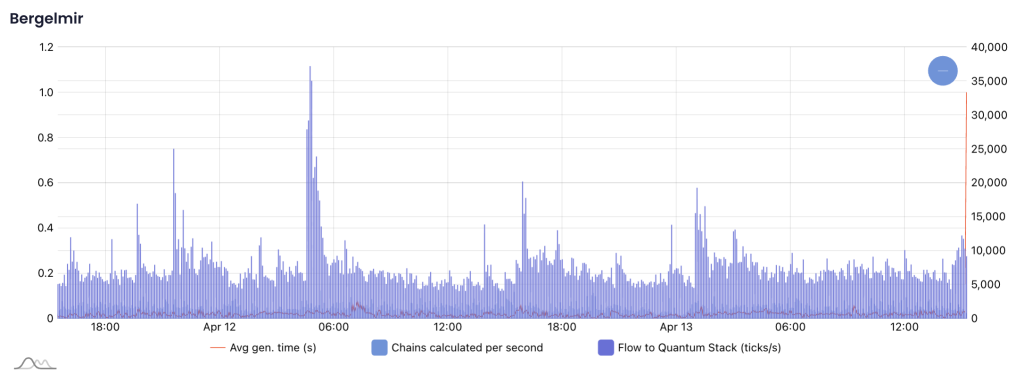
High-frequency tick flow and continuous arbitrage chain recalculation under real market load.
This leads to a key conclusion:
Arbitrage opportunities most often fail not during execution, but before execution even begins.
Generation Time as a Filtering Mechanism
In advanced arbitrage systems, generation time is not just a metric — it is a constraint. Opportunities that exceed a certain delay threshold are discarded before execution. This protects the system from acting on stale data.

Generation time is enforced as a system-level constraint, not just monitored.
In addition, the system may validate price alignment with the current orderbook, consistency of execution conditions, and the availability of liquidity. This allows the system to filter out even those opportunities that appear valid but no longer reflect the market.

Additional validation ensures that calculated opportunities remain aligned with the current order book.
The goal is not to execute faster. The goal is to execute only what is still relevant.
The Trade-Off Between Speed and Stability
There is always a trade-off in arbitrage systems.
You can relax constraints by accepting higher generation time, allowing larger price deviations, and increasing the number of opportunities. This leads to higher trading activity.
However, it also increases slippage, execution errors, and the gap between calculated and actual results.
As a result, the system becomes more active — but less stable.
Why Most Arbitrage Bots Ignore Generation Time
Many arbitrage bots focus on detecting price differences and triggering trades. They assume that once an opportunity is identified, it remains valid long enough to be executed.
In practice, this assumption often fails.
Without accounting for generation time, a system begins to act on data that no longer reflects the current market.
Generation time is not just a technical parameter — it is a core element of arbitrage execution. It determines whether a system operates on real market conditions or on a delayed model of them. If generation time is not controlled, execution speed becomes irrelevant.
If you don’t control generation time, you are not trading the market.
You are trading its past.