
Starting an arbitrage system is often associated with the moment real trading begins. In practice, however, even a correctly designed arbitrage strategy can encounter problems during execution.
An arbitrage system may identify profitable price differences between exchanges, but successful trading depends on whether all trades in an arbitrage chain can actually be executed. If one leg of the chain fails to close, the remaining open positions may expose the trader to market risk.
For this reason, stable arbitrage system operation requires careful control of execution conditions and continuous observation of system behavior. Modern arbitrage platforms therefore include mechanisms that allow users to analyze system activity, validate configuration parameters, and observe execution outcomes under real market conditions before committing real capital.
Simulation Mode in Arbitrage Systems
One of the most important mechanisms for safe arbitrage operation is simulation.
The simulate: true mode allows an arbitrage system to operate on live market data while completely disabling the sending of real orders to exchanges.

Simulation mode enabled — the system operates on live market data without sending real orders.
When simulation mode is enabled, the platform processes orderbook data, constructs arbitrage chains, and calculates the result of the chain as if the trades had been executed on the market. However, no real orders are placed and no real funds are used.
This allows users to observe how arbitrage chains behave under real market conditions. Traders can analyze how chains are generated, how they close under current liquidity conditions, and what execution results a particular system configuration produces.
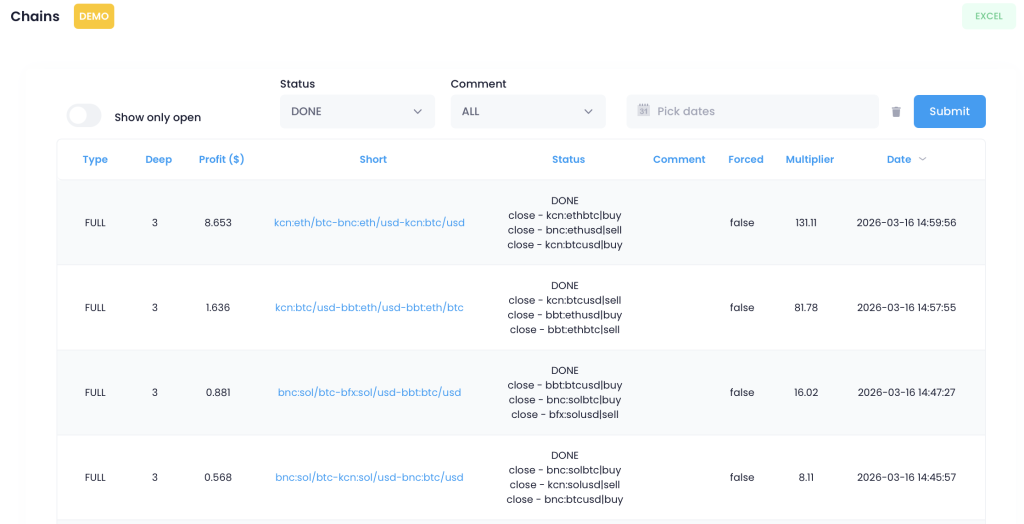
Simulated arbitrage chains with calculated execution results.
Simulation therefore makes it possible to evaluate system behavior and verify configuration parameters before enabling real trading.
AI-Based Execution Forecasting
Execution risk is one of the central challenges in arbitrage trading. Even when price calculations are correct, a chain may fail because liquidity disappears or market conditions change during execution.
To address this problem, HETHA.IO includes an AI Module that forecasts the execution behavior of arbitrage chains before they are allowed to run. The module operates through two models.
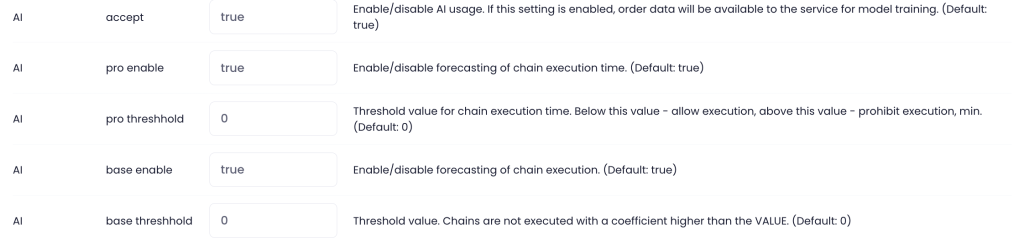
AI Module configuration — Base and Pro execution forecasting parameters.
The Base model performs a preliminary assessment of execution feasibility using a basic set of system and market parameters. Its goal is to estimate whether the arbitrage chain has a sufficient probability of closing successfully. This model is applied through the base_threshold parameter, which restricts chains with a higher probability of unsuccessful execution.
The Pro model performs a deeper forecast of chain closing time using an extended set of market indicators. The pro_threshold parameter blocks chains whose predicted execution time exceeds the defined limit.
Importantly, the AI Module does not search for arbitrage opportunities and does not influence profitability calculations. Its role is limited to providing an additional execution risk control layer.
Capital Distribution in Multi-Exchange Arbitrage
In multi-exchange arbitrage systems, capital is distributed across several exchanges and currencies. Over time, funds may accumulate on certain exchanges or remain locked in specific assets, which reduces the number of arbitrage chains that the system can execute.
To maintain stable system operation, capital distribution must occasionally be rebalanced.
HETHA.IO provides a mechanism called Force Reverse, which allows the system to perform reverse operations that redistribute accumulated assets across exchanges.
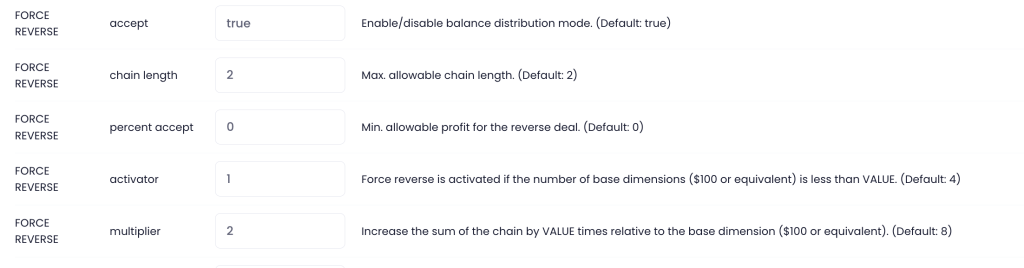
Force Reverse configuration — parameters controlling reverse operations
When the force_reverse.accept parameter is enabled, the platform can automatically perform such reverse trades, restoring balance between exchanges and currencies. This ensures that capital remains available for new arbitrage chains and reduces the need for manual fund transfers.
Maintaining balanced capital distribution is an important factor for long-term arbitrage system stability.
Monitoring Arbitrage System Behavior
Stable arbitrage system operation requires continuous monitoring.
HETHA.IO provides several monitoring components that allow users to observe how arbitrage chains are processed and how the trading engine behaves in real time. System panels, execution logs, chain processing indicators, and capital movement statistics together provide a clear view of system activity under current market conditions.
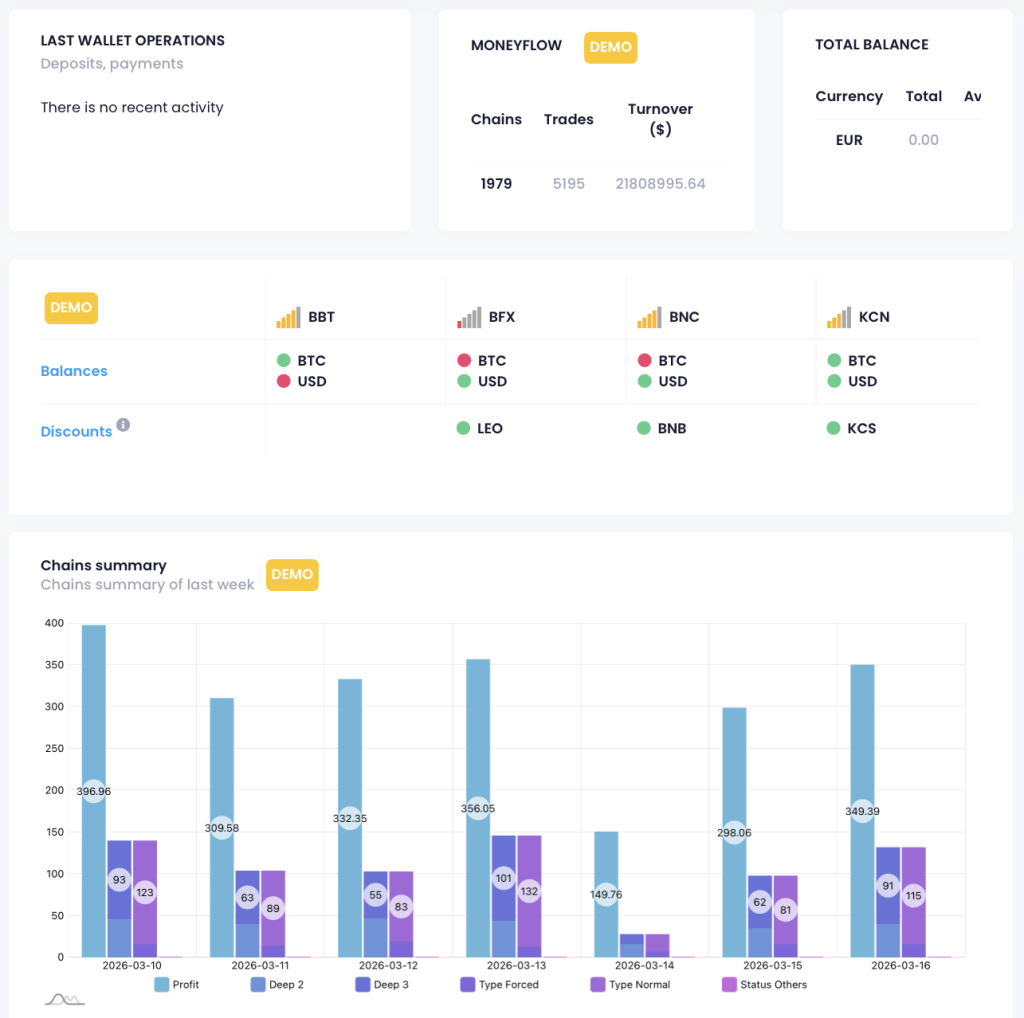
System dashboard showing simulated trading activity and chain statistics.
Observing system behavior during simulation and monitoring system activity are essential steps before transitioning to live trading with real capital.