
Starting an arbitrage system is often associated with the moment real trading begins. In practice, however, launching a strategy directly with real capital can expose traders to unnecessary risk before the system’s behavior is fully understood.
For this reason, many trading infrastructures begin with simulation. Crypto arbitrage simulation allows traders to observe how a strategy behaves under real market conditions without risking capital. Instead of sending real orders to exchanges, the system models the trading process using live market data and calculates results as if trades had been executed on the market.
HETHA.IO follows this approach by introducing users to arbitrage through a structured simulation environment before any real trading begins.
What Is Crypto Arbitrage Simulation
Crypto arbitrage simulation is a method of testing arbitrage strategies without executing real trades. The system operates on live market data and builds real arbitrage chains between exchanges.
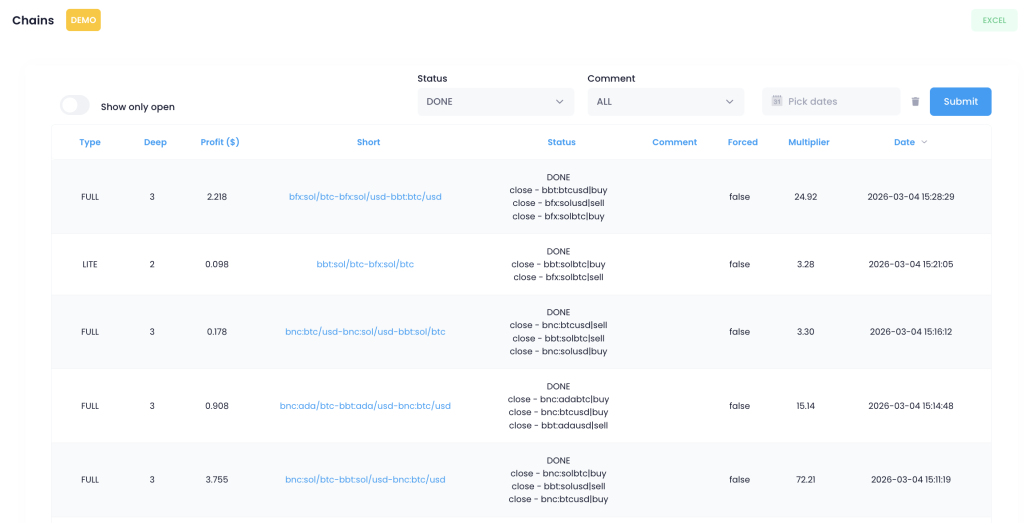
Example of simulated arbitrage chains generated from live market data
Exchange fees, orderbook liquidity, and execution constraints are taken into account in the same way they would be during live trading. The only difference is that trades are simulated rather than sent to exchanges. This approach allows traders to evaluate how a strategy behaves before committing real funds.
In HETHA.IO, simulation is not simply a demo interface. It represents a full model of the trading process that reflects real market conditions while eliminating capital risk.
How Arbitrage Simulation Works in HETHA.IO
The simulation environment in HETHA.IO mirrors the structure of real trading. The system connects to multiple exchanges, monitors exchange balances, and continuously generates arbitrage chains based on live orderbook data.
Instead of executing trades, the system calculates the result as if those trades had been executed on the market. This makes it possible to evaluate how arbitrage chains would behave under current market conditions while keeping capital completely outside the trading process.
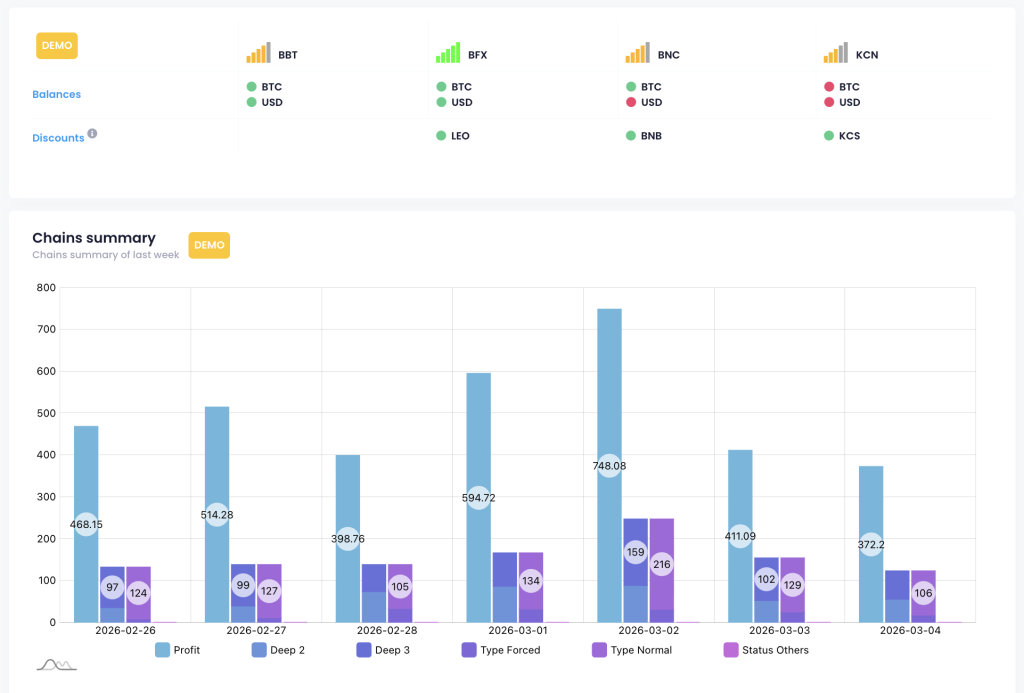
The simulation dashboard displays connected exchanges, asset balances, and chain statistics, allowing users to observe the system’s behavior in real time.
Demo Simulation in the Free Plan
The Free plan provides access to demo simulation. In this mode the system operates entirely in simulation and displays the overall results generated by the strategy under fixed parameters. Configuration settings cannot be changed at this stage.
The purpose of the demo is to demonstrate how the system behaves with its default configuration and to give users a general understanding of how arbitrage chains are generated and evaluated.
This stage allows users to observe the mechanics of the system before moving to strategy configuration.
Simulate Mode in the Pro Plan
Upgrading to the Pro plan introduces a more advanced stage called Simulate mode.

Example of configuration parameters available in Simulate mode
Here the system continues to operate in simulation, but users gain control over configuration parameters. Different system settings can be tested and their results compared under the same live market conditions. This stage is used to identify stable configurations before transitioning to real trading.
Once suitable parameters have been selected, the system can be switched from simulation to live trading. At that point, the same arbitrage chains that were previously simulated begin executing with real orders and real capital.
Recommended Workflow for Starting Crypto Arbitrage
Because of this structure, the recommended startup process follows three stages.
Users first observe the system through demo simulation in order to understand how arbitrage chains are generated and evaluated. Next, Simulate mode is used to test and tune configuration parameters under live market conditions. Only after this stage does the system transition to live trading with real funds.
Skipping simulation removes an important validation step. For this reason, the system is designed to introduce users to arbitrage gradually before any real capital becomes involved.